Research · September 2026
We trained for Latvian–Russian phone calls. Our detector caught 82% of Russian-speaking callers.
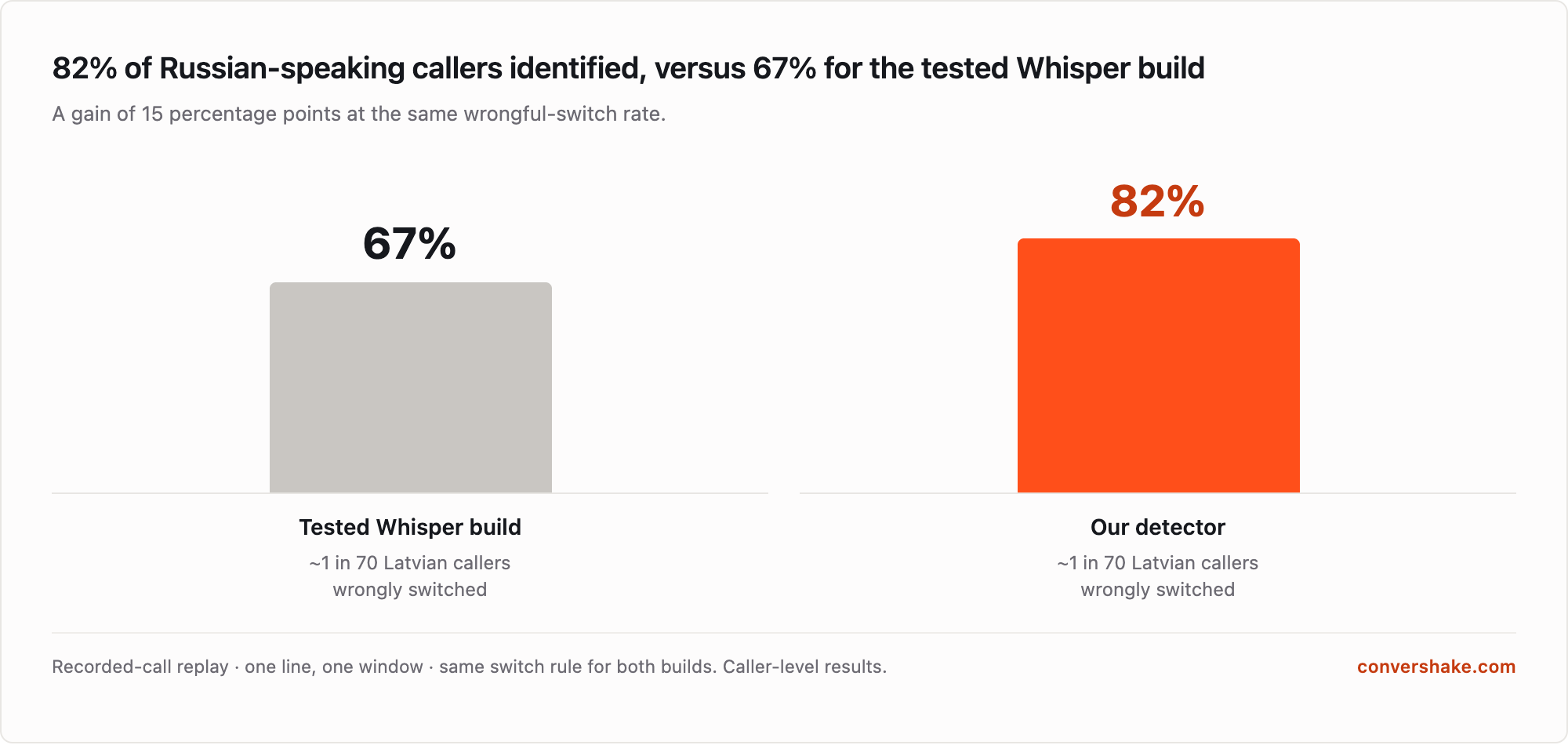
We trained a model to distinguish Latvian from Russian speech on real phone calls in Latvia. It processes a speech fragment in about 21 milliseconds versus 0.7 seconds for Whisper small on the same test machine, roughly 35× faster. In a replay of recorded calls, the detector built on it identified 82% of Russian-speaking callers, compared with 67% for the off-the-shelf Whisper build we tested. Both used the same switch rule and wrongly switched about one Latvian-speaking caller in 70.
82% of Russian-speaking callers identified, versus 67% for the tested Whisper build
A gain of 15 percentage points at the same wrongful-switch rate.
wrongly switched
wrongly switched
Recorded-call replay · one line, one window · same switch rule for both builds. Caller-level results.
Vitālijs Silins-Ozerson LinkedIn
CTO & co-founder · 8 September 2026
This is the second of two Convershake research articles. Part one measured off-the-shelf models on real Latvian phone audio. This part measures our trained model and the detector built on it.
What improved on recorded calls
Our detector identified 82% of Russian-speaking callers, compared with 67% for the tested off-the-shelf Whisper build. That is a gain of about 15 percentage points on the same replay, at the same observed wrongful-switch rate on Latvian-speaking callers.
Both outcomes matter on a bilingual line. The system needs to recognise a caller speaking Russian without switching a caller who is speaking Latvian incorrectly. In this replay, both builds wrongly switched about one Latvian-speaking caller in 70.
These are recorded-call results from one line and one recording window. Live field performance and results on another customer’s line require their own measurements.
What we measured
Our model classifies individual speech fragments. Our detector makes the language-switch decision for a caller. Fragment results describe the model; caller results describe whether a Russian-speaking caller would have been switched during a replay of the recorded call.
We evaluated recorded Latvian and Russian phone audio, with native speakers labelling the correct language. A separate synthetic-audio evaluation tested how the model rankings changed. Processing times were measured on the same MacBook Pro with an M5 Max chip. The AiLab models used a different serving setup and are excluded from the latency comparison.
At fragment level, we report the share of Russian speech fragments identified and the share of Latvian fragments wrongly flagged. Decision rules were selected under a strict error constraint on separate calls from those used to report the results. Each model’s observed error rate on the unseen calls is printed in the scorecard; those rates are not identical.
At caller level, we replay recorded calls and score whether a Russian-speaking caller would have been switched at any point. We also report how many Latvian-speaking callers would have been switched incorrectly. The 82% and 67% results use the same switch rule and have the same observed wrongful-switch rate. A wrongly flagged fragment and an incorrectly switched caller are different units.
Why we trained for this phone audio
Part one showed the gap between a language-support claim and a real phone call. Whisper small labelled 60% of the tested Latvian speech fragments as English and only 2.8% as Latvian. The dedicated language-ID models also struggled with the same audio.
A clean synthetic evaluation changed which model appeared best. VoxLingua107 identified 93% of Russian speech fragments on synthetic audio and 20% on real phone audio under the same evaluation constraint. The general models’ synthetic results overstated their real-audio performance by 2× to 4.6×.
We trained our own Latvian–Russian detection model on real telephony audio, at the bandwidth and codec a phone line delivers, with native speakers labelling the correct language. We then measured it on real phone audio too.
Latvian becomes a useful answer
On the tested Latvian phone speech, our model labels roughly nine fragments in ten as Latvian. Whisper small labelled 2.8% as Latvian in part one. When our model gets a Latvian fragment wrong, it labels it Russian, the other language in the task.
Separately, the median score our model assigns to Latvian on Latvian speech is 0.90, compared with 0.0006 for Whisper small. The plot shows model scores. The label and detection results measure correctness; a score of 0.90 is not itself a measured 90% success rate.
Median Latvian score: 0.90 for our model; under 0.03 for the multilingual models shown
Internal test · real Latvian telephony speech · native-speaker ground truth · median model score for Latvian, same input for every model. Scores are not accuracy rates.
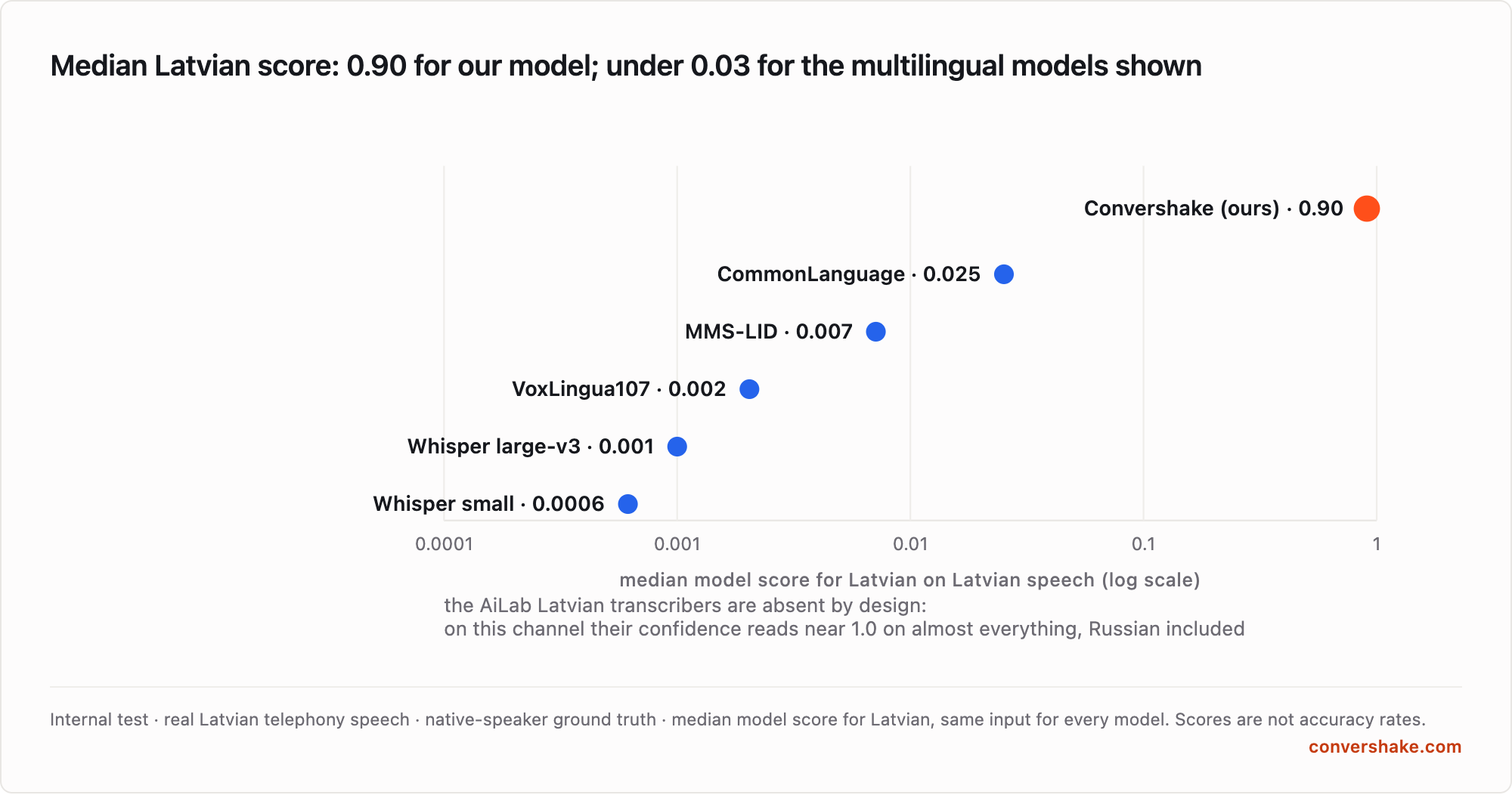
The general multilingual models shown assign very low scores to Latvian on this audio. The AiLab Latvian transcription models behave differently: they assign high Latvian scores to almost everything on the phone audio, Russian speech included. They are discussed separately below.
37% of Russian fragments, with much lower processing time
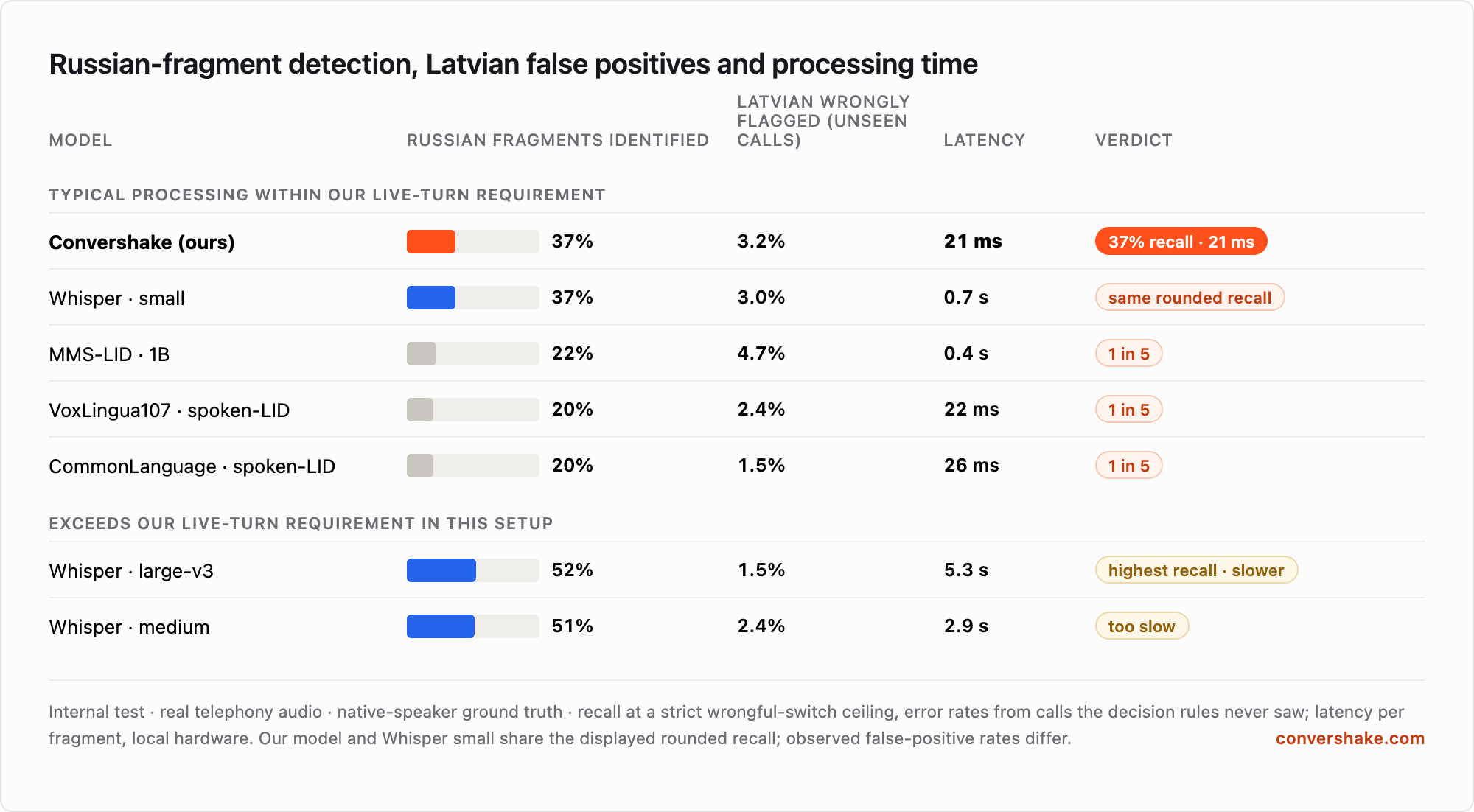
Our model and Whisper small both identify 37% of Russian speech fragments at the reported evaluation point. Their observed false-positive rates on unseen Latvian fragments are 3.2% and 3.0%, respectively. The rounded recall result ties; it does not establish identical performance at every operating point.
Whisper medium and large-v3 identify more Russian fragments, at 51% and 52%. Their processing times on the test machine exceed the live-turn requirement of the setup we evaluated. The scorecard separates recall, errors and latency so the tradeoff is visible.
Russian-fragment detection, Latvian false positives and processing time
| Model | Russian fragments identified | Latvian wrongly flagged (unseen calls) | Latency | Verdict |
|---|---|---|---|---|
| Typical processing within our live-turn requirement | ||||
| Convershake (ours) | 37% |
3.2% | 21 ms | 37% recall · 21 ms |
| Whisper · small | 37% |
3.0% | 0.7 s | same rounded recall |
| MMS-LID · 1B | 22% |
4.7% | 0.4 s | 1 in 5 |
| VoxLingua107 · spoken-LID | 20% |
2.4% | 22 ms | 1 in 5 |
| CommonLanguage · spoken-LID | 20% |
1.5% | 26 ms | 1 in 5 |
| Exceeds our live-turn requirement in this setup | ||||
| Whisper · large-v3 | 52% |
1.5% | 5.3 s | highest recall · slower |
| Whisper · medium | 51% |
2.4% | 2.9 s | too slow |
Internal test · real telephony audio · native-speaker ground truth · recall at a strict wrongful-switch ceiling, error rates from calls the decision rules never saw; latency per fragment, local hardware. Our model and Whisper small share the displayed rounded recall; observed false-positive rates differ.
What the speed made possible
Our model processes a fragment in about 21 milliseconds, compared with about 0.7 seconds for Whisper small and 5.3 seconds for Whisper large-v3 on the same test machine. These are inference times per fragment, not the total time a caller waits for an answer.
Processing time per fragment: our model 21 ms; Whisper small 0.7 s; large-v3 5.3 s
Internal test · per-fragment inference on the same MacBook Pro (M5 Max); excludes the rest of the call system. AiLab models absent: different serving stack, latency not comparable.
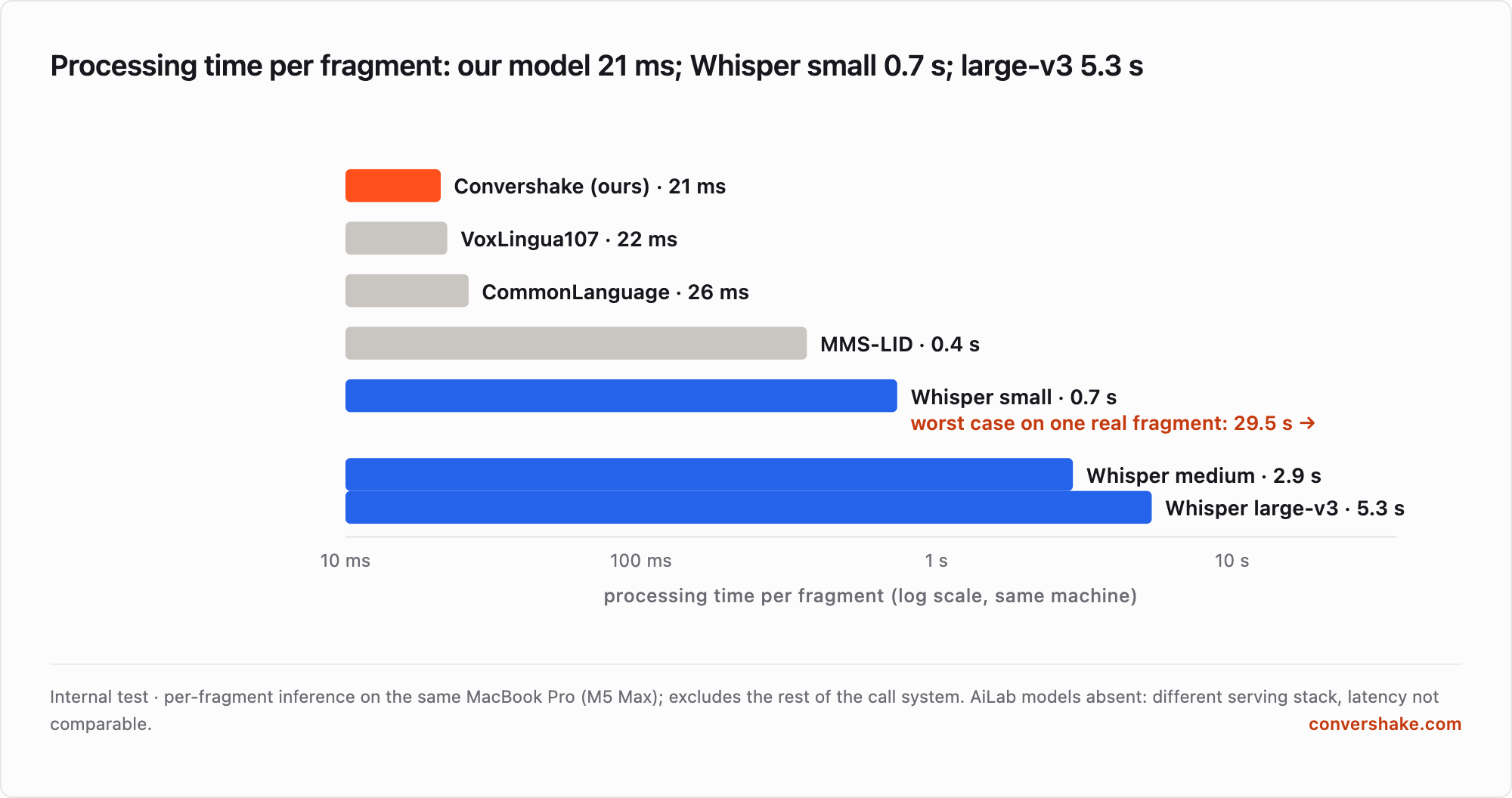
Whisper small keeps up on a typical fragment in this setup, but its worst measured fragment took 29.5 seconds. Our model’s lower processing time gave us room to make the decision per caller. We measured that outcome separately in the recorded-call replay.
The caller comparison, including the lower-error result
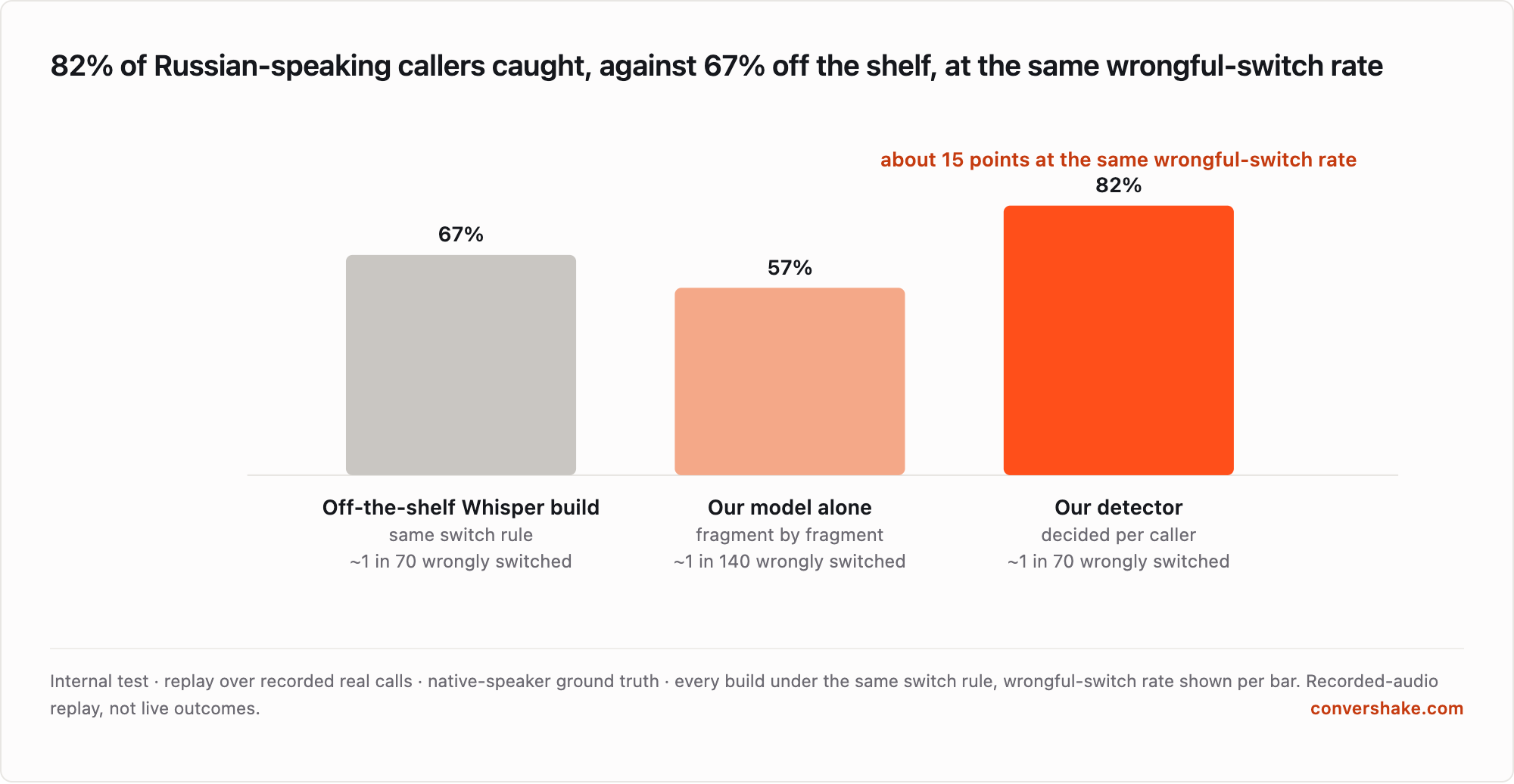
The matched comparison is 82% versus 67%, with both builds at about one incorrect switch per 70 Latvian-speaking callers. Our model alone, judged fragment by fragment, identifies 57% of Russian-speaking callers at a lower wrongful-switch rate, about one Latvian-speaking caller in 140.
The 57% bar has a different observed error rate, so it is not an equal-error comparison with the other two bars. All three results are shown below with their error rates. The 82% result belongs to our detector deciding per caller.
82% of Russian-speaking callers caught, against 67% off the shelf, at the same wrongful-switch rate
Internal test · replay over recorded real calls · native-speaker ground truth · every build under the same switch rule, wrongful-switch rate shown per bar. Recorded-audio replay, not live outcomes.
The Latvian specialists and the evaluation channel
The University of Latvia’s Institute of Mathematics and Computer Science, AiLab, publishes openly licensed Latvian transcription models: AiLab-IMCS-UL/whisper-large-v3-lv-late-cv17 and AiLab-IMCS-UL/whisper-large-v3-lv-phono. They recognise accented Latvian as Latvian, a useful capability. They were built to transcribe Latvian; bilingual language detection is a separate task.
We evaluated them as bilingual detectors because a team building for this market may consider using them that way. On synthetic audio, lv-late-cv17 identifies about 40% of Russian speech fragments; on real phone audio, about 1.3%. For lv-phono, the results are about 23% and 1.0%. The synthetic results overstate real-audio detection by about 31× and 23×, respectively.
The Latvian specialists: 40% on clean synthetic audio, 1% on real calls, 31× overstated
Internal test · Russian speech caught at a matched wrongful-switch ceiling, decision rules set on calls the reported rates never saw; synthetic slice cut to the same fragment lengths. Dashed: the AiLab Latvian transcribers, measured at a job they never claimed.
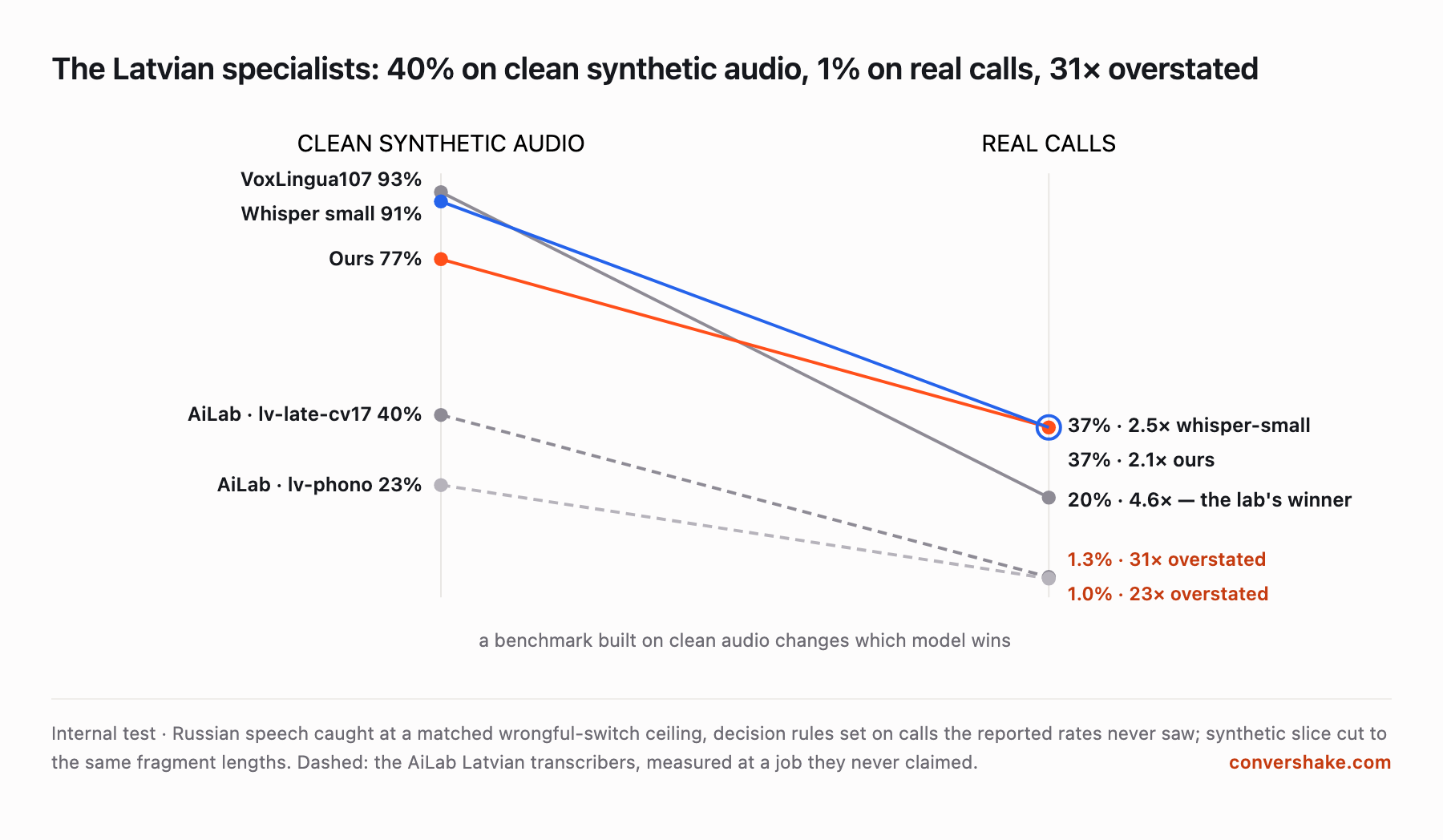
On the real phone audio, both models label almost everything Latvian, including Russian speech. This is a result for the detection task we evaluated, not a verdict on their Latvian transcription quality. The synthetic-versus-real difference shows why the evaluation channel matters; this comparison does not isolate which audio characteristic caused the drop.
What to ask before a pilot
A claim that a model is tuned for a language or a phone channel should come with a comparison on the calls the system will serve. These are the questions we would bring to that discussion.
- What audio was used to train the model, and what audio was used to evaluate it?
- Ask for both. Our comparisons show that clean synthetic audio can overstate detection performance on real phone calls and change which model appears best. Ask for evaluation on actual calls from the intended line.
- How often does the system switch a Latvian-speaking caller incorrectly?
- Ask for that rate alongside the share of Russian-speaking callers identified. Compare systems at the same wrongful-switch rate. A higher detection rate can otherwise conceal more incorrect switches.
- Does the result describe speech fragments, recorded callers or live operation?
- Each answers a different question. Ask for the unit, the evaluation audio and whether the decision rules were set on separate calls. Our 82% and 67% results describe callers in recorded-call replay; a live field rate needs its own measurement.
What these results do not establish
The caller results cover one line and one recording window. They are replay measurements, not live outcomes or a forecast for another customer’s line. Decision rules were set on separate calls from those used to report the results.
The external caller-level comparison is one configuration of one Whisper tier under our switch rule. Larger Whisper tiers were not run per caller because their measured processing time exceeded our live-turn requirement in this setup. Whisper large-v3 remains the most accurate model we measured per fragment.
Nothing here claims a better speech model in general, superiority over every possible configuration, or a statistically significant caller-level difference. Neither article publishes results for commercial cloud APIs. Our model and detector are described through measured outcomes.
This closes the two-part series. Part one shows how the benchmark changed when we evaluated real phone audio.
Evaluating voice AI for a bilingual market?
In a proof of concept we measure your line before we change anything: your callers, your channel, your ground truth. Then we adapt the detection to that line. The numbers above are what that produced on ours.